Kelzynorva
Trail Blueprint
Trail Blueprint
Couldn't load pickup availability
1. Problem Statement
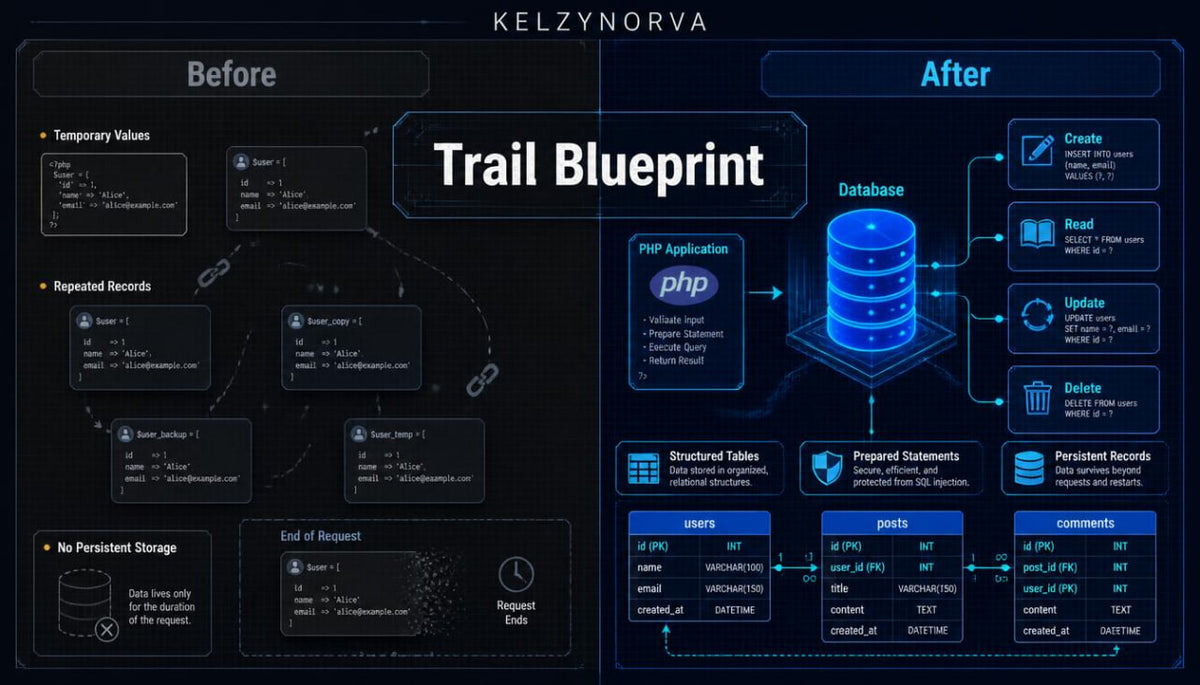
Information stored only during a single request disappears when that request ends. As applications develop, managing records through temporary arrays becomes increasingly difficult. Database operations introduce additional considerations involving data organization, relationships, and validation. Poorly structured queries and inconsistent data handling can create unexpected behavior and unreliable records. Learners need a structured approach to connecting PHP applications with persistent information while keeping individual operations understandable.
2. Solution
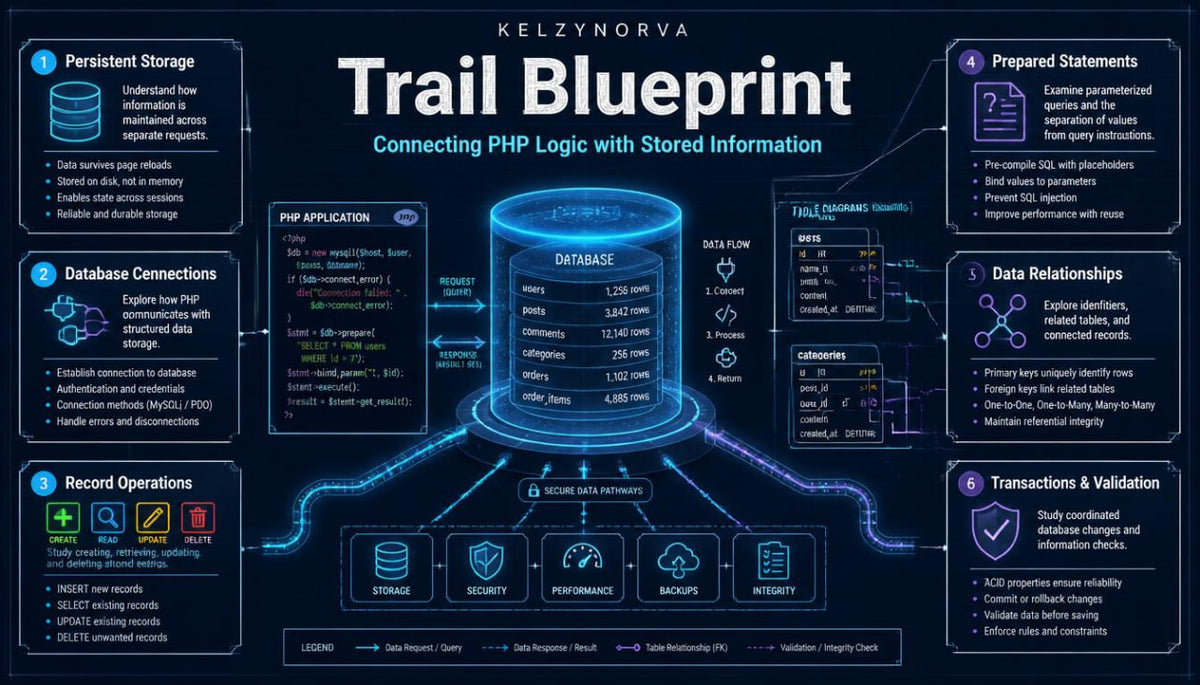
Trail Blueprint introduces database interactions through gradually connected PHP exercises. Each module explains how information moves between application components and stored records. Guided examples demonstrate retrieving, inserting, updating, and removing information with prepared statements. Practical activities examine validation, database relationships, and methods for handling unsuccessful operations. A concluding project brings these concepts together in a structured record-management application.
3. What's Inside
Module 1 — Foundations of Persistent Data
Explore how databases store information between requests, how tables organize records, and why consistent identifiers matter when managing related entries.
Module 2 — Connecting PHP with Databases
Study database connections, connection settings, introductory query execution, and methods for handling connection errors without revealing internal application details.
Module 3 — Retrieving and Filtering Records
Practice selecting stored information, applying conditions, sorting results, and organizing retrieved records into readable PHP structures.
Module 4 — Creating and Updating Information
Examine inserting new entries, modifying existing records, removing outdated information, and checking whether an operation affected the intended data.
Module 5 — Prepared Statements and Validation
Learn how parameterized queries separate submitted values from query instructions, alongside input validation and handling unexpected data.
Module 6 — Relationships and Transactions
Explore connections between related tables, shared identifiers, grouped information, and transactions involving several coordinated database changes.
Module 7 — Applied Database Workshop
Develop a small record catalog with creation, editing, searching, and removal operations, supported by annotated examples and guided testing activities.
4. Who Is This For?
Trail Blueprint is intended for learners familiar with PHP functions, arrays, forms, and introductory application structures. It provides a practical continuation for those interested in database-connected development. The course suits independent learners who want to examine persistent data, structured queries, and organized record-management workflows through written explanations and coding exercises.
5. What You'll Learn
-
Explain how persistent storage relates to PHP applications.
-
Organize information into tables and related records.
-
Establish database connections through PHP.
-
Retrieve and filter stored information using queries.
-
Insert, update, and remove individual records.
-
Apply prepared statements with bound parameters.
-
Validate information before database operations.
-
Interpret relationships between connected tables.
-
Examine transactions and handle database errors.
-
Develop a documented record-management workflow.
6. Guarantee
We offer a 30-day money-back guarantee on all paid digital courses and educational materials available through our store.
If you are not satisfied with your purchase, you may request a full refund within 30 calendar days of the original purchase date.
As our courses are delivered digitally, there is no need to return any physical items. Receiving, downloading, or opening the course materials does not affect your eligibility for a refund under this policy.
Self-paced learning overview
- 📥 Digital file available after purchase
- ♾️ Long-term availability
- 🔒 Secure checkout
- 🗓️ Content updated in 2026
How are Kelzynorva courses organized?
How are Kelzynorva courses organized?
Our PHP Development courses follow a structured learning approach, with each course covering a particular selection of concepts, techniques, and practical exercises. The collection progresses from introductory topics toward more detailed programming subjects, allowing learners to choose materials that align with their current knowledge and interests.
What format do the courses come in?
What format do the courses come in?
Our courses are provided as digital educational materials containing written explanations, organized modules, code examples, and practical learning activities. Each course follows a clear structure so learners can review individual subjects and revisit examples whenever needed.
Do I need previous programming knowledge to begin?
Do I need previous programming knowledge to begin?
The required knowledge depends on the course you select. Introductory materials are intended for beginners, while later courses explore subjects that benefit from familiarity with PHP fundamentals. We recommend reviewing each course description to understand its topics and intended audience.
Share