Kelzynorva
Slate Framework
Slate Framework
Couldn't load pickup availability
1. Problem Statement
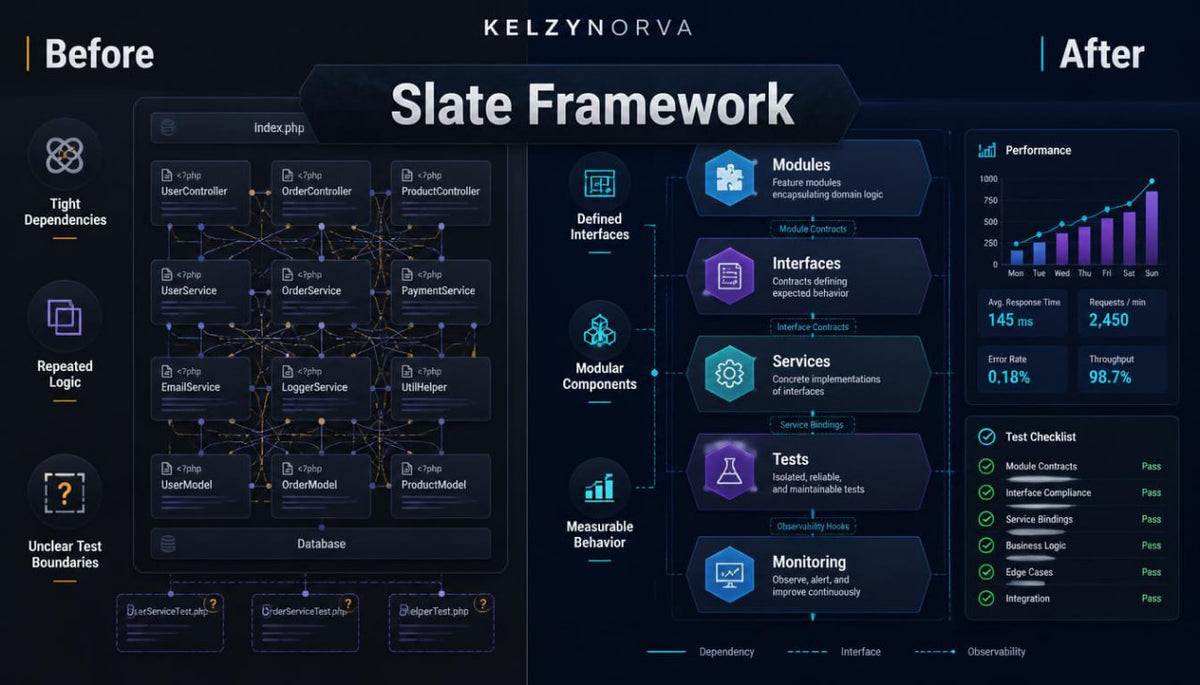
As PHP applications expand, coordinating their components becomes increasingly demanding. Growing codebases may contain repeated logic, unclear dependencies, and inconsistent communication between modules. Changes to one component can affect unrelated features when application boundaries are poorly defined. Performance issues and unexpected behavior can also become difficult to investigate without structured testing and monitoring practices. Learners need practical techniques for examining application architecture, improving code organization, and evaluating how connected components behave.
2. Solution
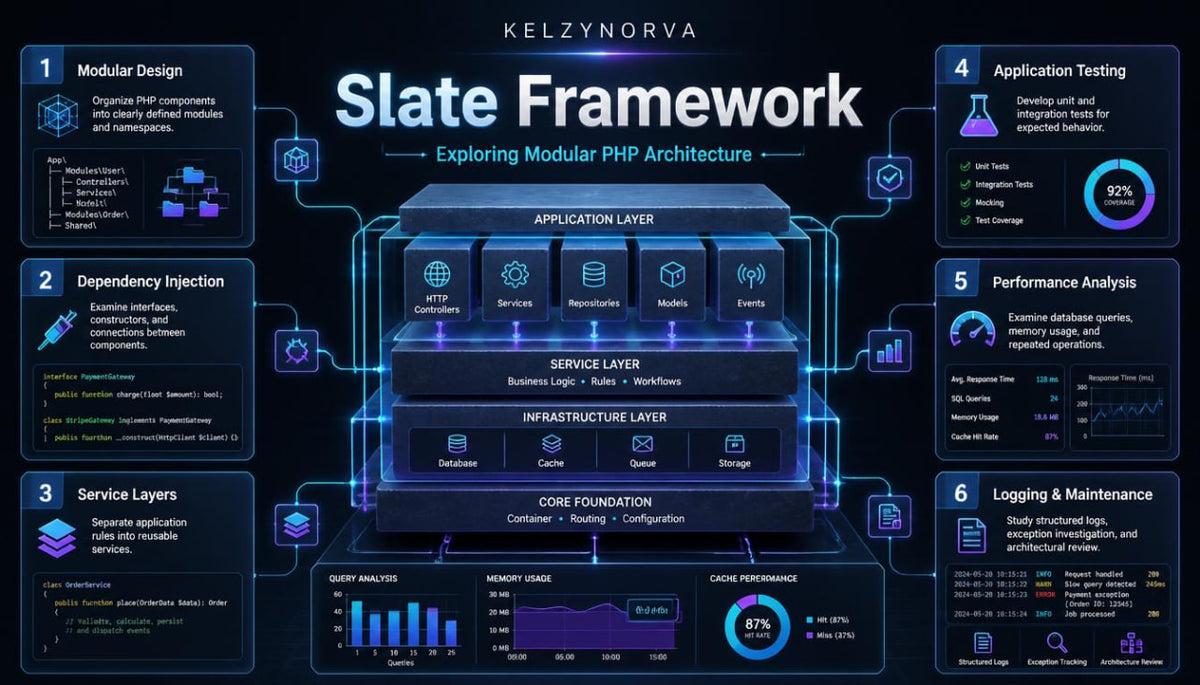
Slate Framework introduces architectural concepts through progressively connected PHP development scenarios. Each module examines a particular aspect of application structure, including component relationships, dependency management, testing, and performance. Annotated examples demonstrate how complex workflows can be divided into smaller responsibilities. Guided activities encourage learners to compare architectural choices and document their implications. A concluding workshop combines modular organization, automated checks, and performance observations within a single application.
3. What's Inside
Module 1 — Architectural Foundations
Examine how larger PHP applications organize request handling, business rules, storage operations, and presentation responsibilities. Study component boundaries and communication patterns.
Module 2 — Modular Application Design
Explore namespaces, class organization, reusable components, and methods for separating features into clearly defined modules.
Module 3 — Dependency Management
Study constructor-based dependency injection, interfaces, and techniques for reducing unnecessary connections between application components.
Module 4 — Structured Service Layers
Examine service classes, data transfer structures, and the coordination of multiple operations within a shared application workflow.
Module 5 — Testing Application Behavior
Develop introductory unit and integration tests, define expected results, examine edge cases, and compare observed behavior with documented requirements.
Module 6 — Performance and Resource Handling
Explore database query patterns, repeated operations, memory considerations, and introductory caching concepts through measurable examples.
Module 7 — Logging and Error Investigation
Study structured logging, exception handling, error categorization, and methods for tracing unexpected behavior without exposing sensitive information.
Module 8 — Architectural Review Workshop
Examine a sample PHP application, identify areas requiring clearer separation, revise selected components, and document architectural decisions.
Applied Project — Modular Resource Directory
Develop a connected application containing organized services, database operations, validation rules, automated checks, and documented component relationships.
4. Who Is This For?
Slate Framework is intended for learners familiar with PHP classes, database interactions, request handling, and structured application development. It suits individuals interested in examining larger codebases and understanding the reasoning behind architectural decisions. Previous experience with object-oriented programming and application testing concepts is helpful, although introductory explanations accompany the main topics.
5. What You'll Learn
-
Analyze application architecture and component responsibilities.
-
Organize PHP code into modular structures.
-
Apply dependency injection using interfaces.
-
Design reusable application services.
-
Write unit and integration tests.
-
Examine database and application performance.
-
Implement structured error logging.
-
Identify unnecessary component dependencies.
-
Document architectural decisions and code revisions.
6. Guarantee
We offer a 30-day money-back guarantee on all paid digital courses and educational materials available through our store.
If you are not satisfied with your purchase, you may request a full refund within 30 calendar days of the original purchase date.
As our courses are delivered digitally, there is no need to return any physical items. Receiving, downloading, or opening the course materials does not affect your eligibility for a refund under this policy.
Self-paced learning overview
- 📥 Digital file available after purchase
- ♾️ Long-term availability
- 🔒 Secure checkout
- 🗓️ Content updated in 2026
How are Kelzynorva courses organized?
How are Kelzynorva courses organized?
Our PHP Development courses follow a structured learning approach, with each course covering a particular selection of concepts, techniques, and practical exercises. The collection progresses from introductory topics toward more detailed programming subjects, allowing learners to choose materials that align with their current knowledge and interests.
What format do the courses come in?
What format do the courses come in?
Our courses are provided as digital educational materials containing written explanations, organized modules, code examples, and practical learning activities. Each course follows a clear structure so learners can review individual subjects and revisit examples whenever needed.
Do I need previous programming knowledge to begin?
Do I need previous programming knowledge to begin?
The required knowledge depends on the course you select. Introductory materials are intended for beginners, while later courses explore subjects that benefit from familiarity with PHP fundamentals. We recommend reviewing each course description to understand its topics and intended audience.
Share