Kelzynorva
Loom Guide
Loom Guide
Couldn't load pickup availability
1. Problem Statement
Scripts handling related values can become difficult to follow. Repeated checks make revisions harder to manage. Arrays become confusing without consistent naming and retrieval. Functions can shorten a script while still obscuring its meaning if each function has no clear responsibility. Learners need to connect organized data, reusable logic, and readable output.
2. Solution
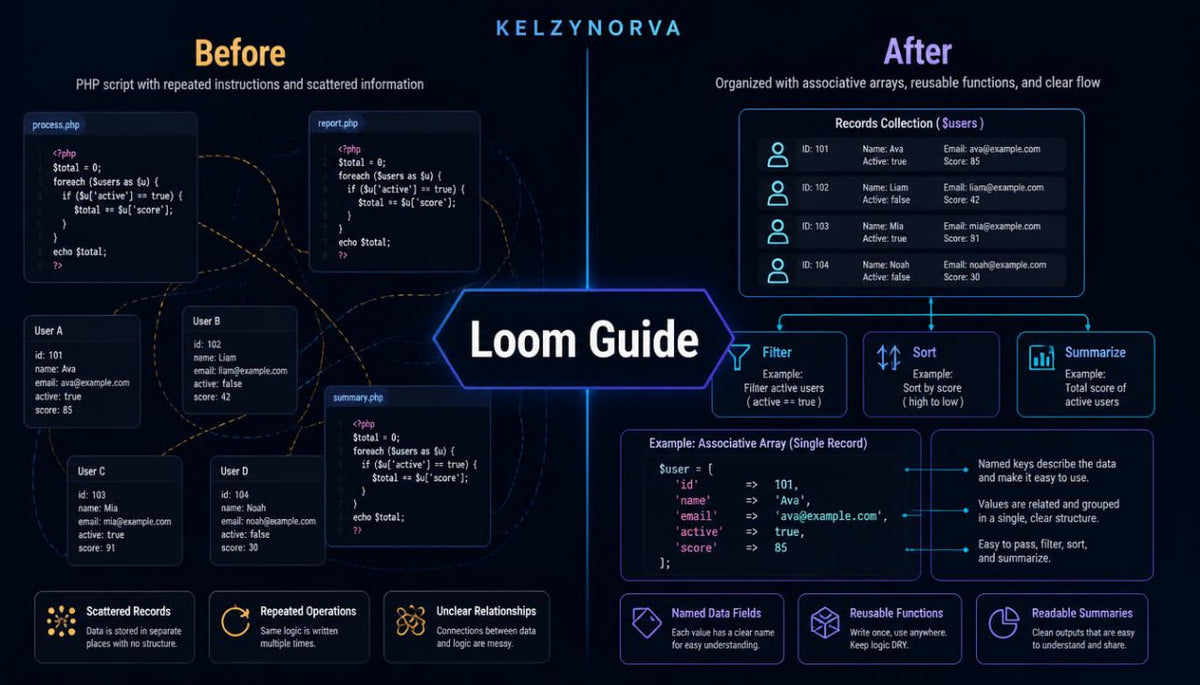
Loom Guide presents small information-handling scenarios that grow from individual statements into organized PHP scripts. Each module identifies a specific task before showing how to divide it into input, preparation, validation, and presentation. Examples explain array structures and function boundaries. Guided revisions compare cluttered and clearer arrangements of identical logic. The final exercise brings these techniques together in a documented record-processing workflow.
3. What's Inside
-
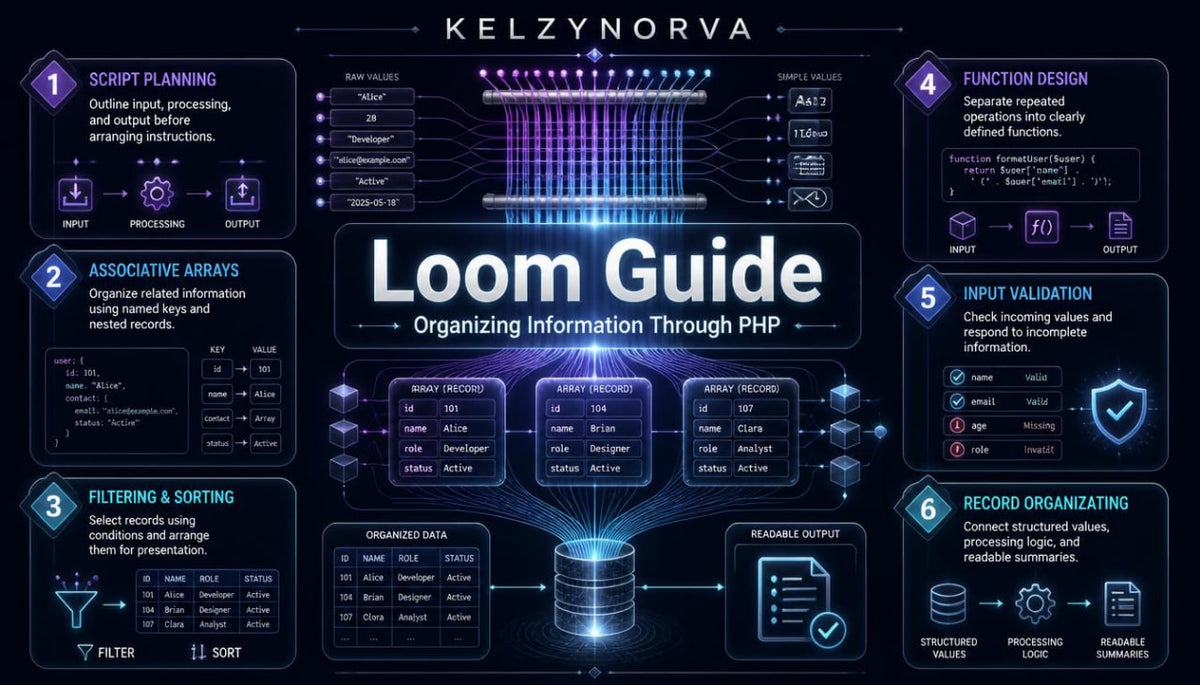
Mapping a Script's Responsibilities: Learn how to outline a task, identify its inputs and outputs, and separate related activities before writing the main instructions.
-
Associative Arrays and Grouped Records: Work with named keys, nested information, missing entries, and sequences of related records; review examples that show how structure affects retrieval.
-
Organizing Functions: Explore parameters, return values, variable scope, descriptive naming, and ways to keep each function focused on a specific activity.
-
Filtering and Sorting Information: Follow examples that select records using conditions, arrange values for presentation, and compare different approaches to iteration.
-
Checking Incoming Values: Examine empty fields, unexpected data types, and basic validation steps, including how to communicate issues without hiding them.
-
Building Readable Output: Turn structured values into clear summaries and text-based displays using consistent labels.
-
Tracing and Revising Code: Investigate unexpected results through test cases and annotated corrections.
-
Applied Learning Studio: Build a compact course-record organizer that stores sample entries, checks their fields, filters records by category, and produces a readable summary. Includes a planning worksheet and reflection questions.
4. Who Is This For?
Loom Guide is intended for learners who have encountered variables, loops, conditions, and basic functions and want to combine them in more organized scripts. It suits independent study and small data-handling tasks. Readers can compare alternatives and document their decisions.
5. What You'll Learn
-
Plan a small PHP workflow around clearly defined tasks.
-
Organize related values with associative arrays.
-
Retrieve, filter, and sort records using readable logic.
-
Separate repeated instructions into focused functions.
-
Check incoming values and describe validation issues.
-
Trace unexpected output with small test cases.
-
Document a script's structure and explain its decisions.
6. Guarantee
We offer a 30-day money-back guarantee on all paid digital courses and educational materials available through our store.
If you are not satisfied with your purchase, you may request a full refund within 30 calendar days of the original purchase date.
As our courses are delivered digitally, there is no need to return any physical items. Receiving, downloading, or opening the course materials does not affect your eligibility for a refund under this policy.
Self-paced learning overview
- 📥 Digital file available after purchase
- ♾️ Long-term availability
- 🔒 Secure checkout
- 🗓️ Content updated in 2026
How are Kelzynorva courses organized?
How are Kelzynorva courses organized?
Our PHP Development courses follow a structured learning approach, with each course covering a particular selection of concepts, techniques, and practical exercises. The collection progresses from introductory topics toward more detailed programming subjects, allowing learners to choose materials that align with their current knowledge and interests.
What format do the courses come in?
What format do the courses come in?
Our courses are provided as digital educational materials containing written explanations, organized modules, code examples, and practical learning activities. Each course follows a clear structure so learners can review individual subjects and revisit examples whenever needed.
Do I need previous programming knowledge to begin?
Do I need previous programming knowledge to begin?
The required knowledge depends on the course you select. Introductory materials are intended for beginners, while later courses explore subjects that benefit from familiarity with PHP fundamentals. We recommend reviewing each course description to understand its topics and intended audience.
Share